A simple classified ad in the 1960s brought talent that would later shake an industry.
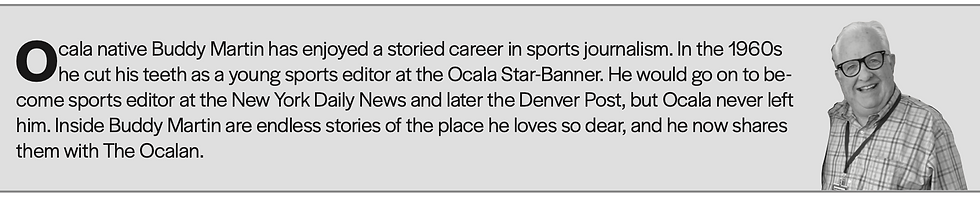
By Buddy Martin
There’s a moment in every newspaperman’s life when he figures out that ink and ambition alone won’t carry the day. You need resources. Bodies. Time. A little money in the till. And when you don’t have any of that, you either fold up the tent… or you start pretending you do.
Back then, my whole universe could be measured between the sports racks at Morrison’s Cafeteria – where I’d stand there, quarters in hand, staring at the big-city sections. The Times. The Constitution. The Herald. Papers fat with staffers and budgets and muscle. They were symphonies.
And there I was in Ocala, a one-man band with a dented horn, trying to sound like Count Basie.
Didn’t matter. I had a professor named Hugh Cunningham who had already put the idea in my head that this wasn’t just a job – it was a calling.
“You’re special,” he told me. “You’re going to be an editor someday. But you better give a lot of effort.”
That was all I needed. Maybe all I had.
So I gave it everything.
Because if you don’t have resources, you better have nerve.
The Star-Banner had decided it was going to “expand” coverage – one of those fine, optimistic words publishers like to use when they don’t plan to hire anybody.
Suddenly we weren’t covering a handful of schools anymore. We were up to 17 high schools scattered across four counties – from Ocala to Cedar Key to Jasper, even six-man football tucked away in places you needed a map and a prayer to find.
And it was still just me.
So I went upstairs and made my pitch.
“I need help,” I said. “Let me hire some guys. I’ll pay them five, maybe ten bucks a story.”
To their everlasting credit – or perhaps because they didn’t realize what they were unleashing – they said yes.
I ran a classified ad.
What came through the door wasn’t exactly the cavalry.
Three kids. Two of them brothers. Teenagers. No clips, no experience, no idea what they were doing. But they had that look – the one you can’t teach.
Hunger.
It took me about two seconds to decide they were perfect.
Spring of ’63. I was 25, already tired enough to be 50, and desperate enough to believe in anything that might work.
“Here’s the deal,” I told them. “You’re covering high school football. Anywhere I send you. Friday nights. Five bucks.”
No one blinked.
Jay McKenzie, the older brother, said he was a photographer.
Turned out he was. Years later, he’d wind up running the whole show at the Banner as managing editor.
Jim Waldron was the steady hand – the friend who just wanted to write about ball games. Did it for me for years in Cocoa, then went home and started his own paper in South Marion like a man staking his own claim.
Van McKenzie, the younger brother – fresh out of junior college, 18 years old – raised his hand and volunteered for Jasper. Two hundred miles round trip in a tired Thunderbird that would drink more gas than he’d earn.
Didn’t matter.
He couldn’t even type. Wrote everything in No. 2 pencil on a yellow pad like he was taking dictation from The Almighty.
But he wanted it. And that’s all you really need to start.
From that beginning, Van went on to become one of the best in the business behind the sports desk. In the mid-1970s after yours truly had left as sports editor of the St. Pete times, he took over the position. What ensued was his section winning the Associated Press Sports Editors award for the Best Sports Section two years in a row. From there, his reputation only grew and would never fade.
I tried to do my part to carry the Ocala flag years later as sports editor of the Denver Post when we were named the top Sunday sports section in America, much to the chagrin of the brass at the Los Angeles Times, who decided it was then time to change the rules of the award so that it would then recognize a top ten instead of a single best.
Through those humble doors of the Star-Banner in the 1960s walked fresh, young talent that would set the world on fire, whether we knew it at the time or not. But we all had dreams of making it big someday somewhere else, and those dreams came to fruition.
What we had wasn’t experience. It wasn’t polish.
It was belief. And a willingness to outwork anybody who thought they were better than us.
We built that section piece by piece, story by story, mile by mile across North Central Florida. Friday nights turned into Saturdays. Saturdays bled into Sundays. Eighteen-hour days stacked up like cordwood.
And every once in a while – usually somewhere around midnight, when the pages were put to bed and the presses were about to roll – we’d step outside into the humid Florida night, dead tired and grinning like fools.
And we’d say it out loud, half joking, half daring the world to argue:
“We did it! We were the best sports section in America tonight.”
And here’s the thing.
On those nights?
We were.
Not because we had the most people. Or the most money. Or the cleanest copy.
But because we decided we were – and then worked like hell to make it true.