
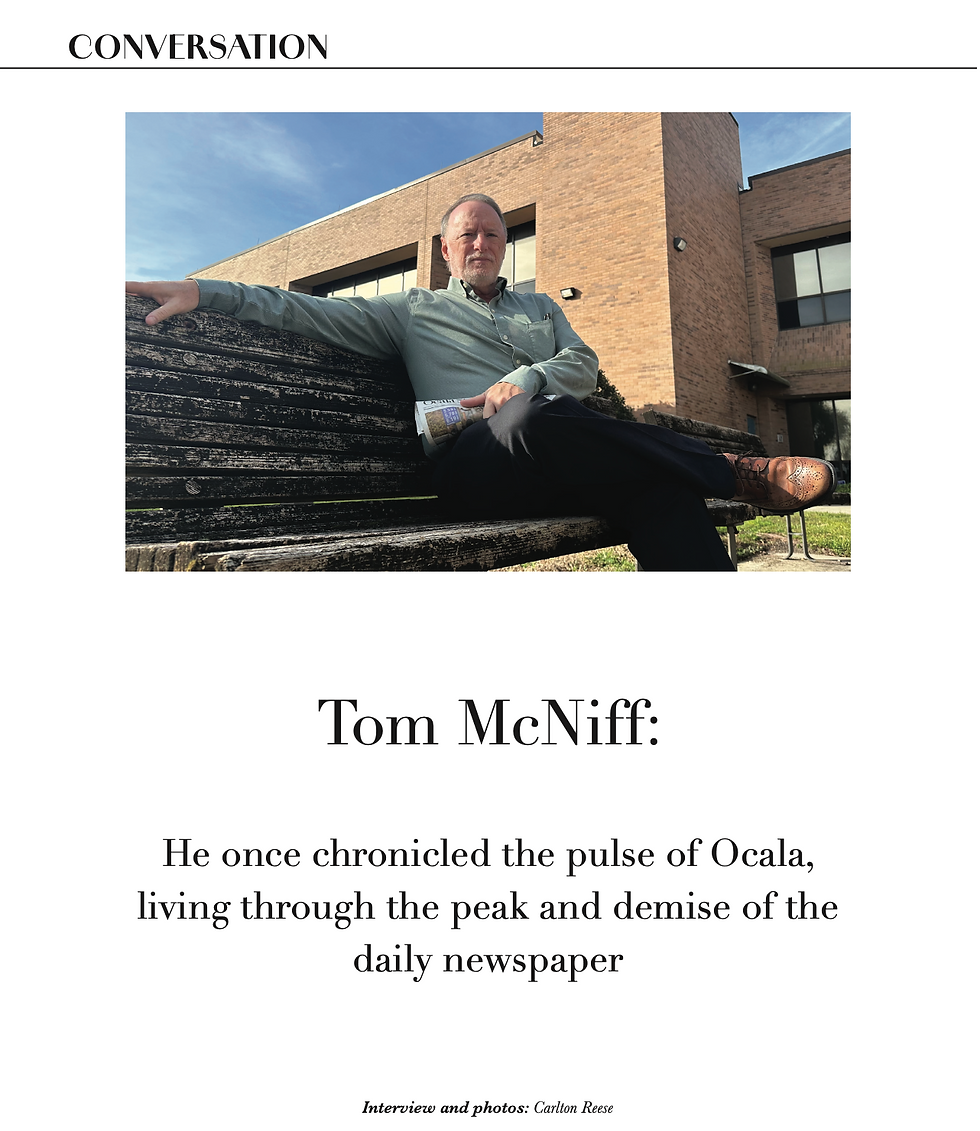
The 1990s are generally seen as the last hurrah of the newspaper industry’s great influence on the culture. Beginning in the mid-2000s with the rise of alternative internet media, newspapers across the country began to dwindle in size and numbers and what is left today are cavernous newsrooms and only a few die-hards still clinging to the daily delivery of print news.
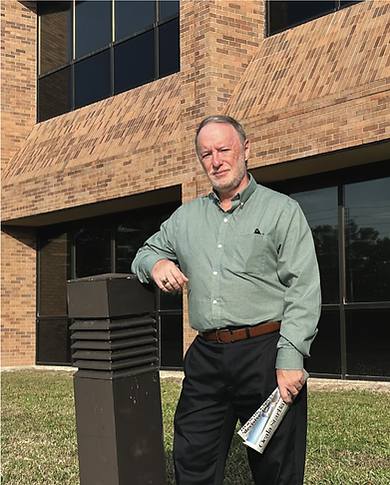
As a reporter and editor, Tom McNiff thrived in the belly of the beast during the glory days and would be among the leading executives locally to be dismissed during the grand layoffs of the industry. After graduation from St. John’s University, McNiff worked in New York as a reporter for one of the largest weekly newspapers in the country before moving to Florida, where he hooked up with the Palatka Daily News. Soon after, he would cover city and county at the Ocala Star-Banner, where he earned a reputation as an aggressive reporter.
He moved from reporting to the editor’s desk where he was groomed to move up the industry ladder, from City Editor in the mid-1990s to Assistant Managing Editor, then ultimately Managing Editor.
In 2013, McNiff left the Star-Banner to help revive the Leesburg Daily Commercial as Executive Editor. Bringing that publication from brink to respectability in a few short years is one of the feathers in McNiff’s cap. But, like what was happening all over the country, the Daily Commercial would eventually succumb to industry pressures and in 2019 he was let go from that position.
Undaunted, McNiff’s expertise was called upon by Jennifer Murty to help her new weekly newspaper The Ocala Gazette get up and running, which he did so in an advisory role.
McNiff sat down with The Ocalan to discuss the industry, some of the moments that stand out to him from his days as a reporter and reveal a little slice of life at the Star-Banner back in those glory days:
The Ocalan
In the 1990s, a newspaper office like the Star-Banner’s was humming with dozens and dozens of writers, editors, photographers, and assistants, but today is hardly of fraction of that. How would you describe those days?
Tom McNiff
What stands out to me are the people. That staff was so good. We had sports reporters of high caliber, terrific writers, really good editors – professionals who were really driven. There was a time when the Star-Banner had 67 people in the newsroom. We had Voz Latina, the Spanish newspaper, and the South Marion Press and all these different publications like Go Magazine. But, look at it today: there are just a couple of people and there isn’t even a newsroom – they work from home. They still do a great job, but it’s sad to see that.
In those days, it was such an energetic place to work, but even in the 90s you were already starting to see some cracks in the foundation.
The Ocalan
Everyone has their theory as to why newspapers have nearly faded away and those center mostly around digital content. What say you?

I'm a paragraph. Click here to add your own text and edit me. It's easy.
Tom McNiff
I think the popular narrative is that newspapers died because they were opinionated or slanted and nobody wants to read them anymore, but nothing could be further from the truth. More people consume news now than ever before – journalism is not dead – it’s just on different platforms.
Very simply, the demise of newspapers was because for years and years, many generations, you had billboards, radio, TV, and newspapers… that’s it, and nothing else. As soon as the internet age dawned and social media right behind it, you had so many ways to get out your message – newspapers were no longer one of the big three or four big advertising mediums.
Of course, newspapers got into digital publishing and social media, but it didn’t matter – the horse was out of the barn and there were too many ways for people to advertise.
The Ocalan
Newspapers still exist in both print and digital, but do you think even those days are numbered given the trends?
Tom McNiff
I think there will always be a place for news. I’m not sure about hard copy newspapers. The Star-Banner is still relevant, especially in digital format. The Ocala Gazette – Jen Hunt Murty started that years ago and she seems to be doing well with that because people still thirst for journalists who can help make sense of what’s going on around them.
It’s interesting right now that the Star-Banner has shrunk its footprint, but there is, like the Ocala Gazette, guerilla journalism, people that will fill in that niche with their own news by explaining what’s going on in the community and I appreciate that. Where it goes from here, I’m not really sure.
The Ocalan
For you, are newspapers just fond memories then?
Tom McNiff
I miss it. When I was a kid, we got three newspapers in the house: We got the New York Daily News, New York Newsday, and the New York Times. I’d start before school with the sports page in the back and I’d tear through that and see how the Yankees did, or the Knicks did. Then, I’d flip to the front, especially the Daily News, and read about the latest mobster who got wiped out in New York – that was exciting. That was my morning, even as a little kid and I miss that a lot.
It’s sad to see, but I’m interested to see where news organizations go from here and who fills that void. I think there’s still plenty of good reporting out there and there are fewer and fewer outlets. A lot of them are joining forces – I don’t even think the New York Times has a sports department anymore; they’re aligned with The Athletic.
The Ocalan
There is a lot of journalism out there, but do you worry about any aspects of it?
Tom McNiff
I do worry about who’s going to hold powerful people accountable. Access (to sources) is so much more controlled today and it feels like a lot of news organizations are powerless to do anything about it. They are controlled by, say, the White House, or congress.
As a working journalist back in the day, as a reporter or an editor, I knew if I called up a congressman for our district and got an aide on the phone that was trying to stiff arm me, in my toolkit was a couple of lines such as “Okay, we’re going to report you refused to answer questions.” They didn’t want to hear that because we had a large circulation – I think 80,000 at one time – so they find a way to get that congressman on the phone to answer questions. I don’t think local newspapers have that ability now, because while you don’t want your local leaders to be afraid of you, you want them to respect the influence you have, and I don’t think that local media has that much influence anymore. I’m not even sure national media does, either.
The Ocalan
Was there a difference in how a reporter went about his job back then compared to today?
Tom McNiff
We used to, as a young reporter, do ride-alongs with cops and firefighters and you’d get an unvarnished view of what their day was like, how they interacted with people, the difficulties of their job and the perks of their job. I don’t know that anybody can do that anymore.
I’d be on ride-alongs and the cops would end up in brawls and there I am with my notebook and camera reporting it all and watching it unfold. They don’t let you do that anymore. Those are important insights into how authorities do their jobs.
Everybody’s become so media savvy, it’s probably more difficult being a journalist now than it ever was, especially at the local level. I greatly respect the people who are still doing it. When I worked for Murty for a while some time back, she asked, “Don’t you still want to do this full-time?” I said, “No,” my time has passed.
The Ocalan
What are some of the moments that stand out during your years at the Star-Banner?
Tom McNiff
I remember 9/11, and that was a watershed moment for the country as a whole. I was on vacation that day and I remember being at home watching TV and saw the first plane hit the World Trade Center. I knew right away it wasn’t an accident, and I turned to my wife and she said, “You’re going to work, aren’t you?” I got dressed and headed in, and everybody was already buzzing. We had to get reactions, talk to the Sheriff’s department and the police department about possible threats to our little community and what they were doing about it.
Everybody was so dialed in: the sports staff, the features staff – everybody stopped what they were working on and contributed to that major news event. We put out a special edition that day in addition to the daily newspaper. It was just so amazing that in the midst of one of the worst things our nation had to endure in 50 years, to see everybody work and get so focused and so determined to do a really good job informing and explaining to people what was going on and what it meant to them.
We were acutely aware this was a generation-changing event, that this would shift the national conversation.
As journalists you feel that passion to be involved. We’re not getting on a plane and carrying a rifle, going to Afghanistan in that moment, but we can contribute; we can help by letting people know what’s going on. It’s an incredible moment for journalists. Same thing with hurricanes – in the aftermath, you can help people navigate the situations, and that’s what most of us thrive on. We help people navigate a complex and even scary situation with good information.
The Ocalan
What about local people you reported on or dealt with? What stands out there?
Tom McNiff
When I was a young reporter at the Star-Banner, Don Greene was a (county) commissioner and he was one of the biggest characters I covered in anything. I was determined to follow him around and report on what he was doing and show him for all his color. I came out with a piece that some people criticized, but I was surprised by the reception. He would do things, like sitting in the county commission office and get on the phone and pretend he was raising funds against the commissioner across the room… just to needle him.
He would boast and brag – just a loud personality. So, I wrote this big piece about him and I thought, “I’m gonna get killed over this story” because nobody will believe it, it is so outrageous. After the story came out, Don called me and asked to go have lunch and I thought, “man, am I gonna get it!” But, he said, “That was me, you got me good; I have to own every bit of that.” I appreciated that and we could laugh about it later.
The Ocalan
What about stories that stand out?
Tom McNiff
When Ed Dean was sheriff, we started to get wind of things going on in the jail. They had a private medical team that treated inmates at the jail and they were doing a bad job, quite frankly. People would get very ill; people died. People who had been booked in the jail on psychotropic medications had them taken away and it was a bad situation. We were getting complaint after complaint after complaint, so we started looking into it.
Dean was so smart and he saw exactly what we were doing and where we were heading with that story and he got ahead of it. He fired (the medical team) and he created an amazing community-based medical team for the jail so that by the time we got done with our investigation and put it out there, this team was already in place and they were already doing terrific work. So, he took the sting out of the story. Instead of it being, ‘Look at this awful situation at the jail with these inmates suffering,’ it became, ‘This had been happening, but the sheriff has fixed this problem.’

The Ocalan
That sounds like the type of story that could have earned you and your team a lot of recognition.
Tom McNiff
I appreciated it, but there was a part of me that wished we got the story before he fixed the problem. He scooped us – more power to him. It would have been an award winner, but we weren’t doing it for awards; we were doing it to bring a problem to light, and he fixed the problem before we could bring it to light.
The Ocalan
What about within the Star-Banner – what was the staff like and were there any heated moments?
Tom McNiff
I think of some of the editors I worked with there, like Jay McKenzie, Bruce Gaultney, Robyn Tomlin, Cherie Beers – amazing people. Laura Byrnes was maybe the best writer I ever worked with, and her husband Joe – just consummate professionals and so passionate about their work. And Bill Thompson was one of the best reporters I ever worked with.
Brad Rogers, who was the Editorial Page editor, is a good friend of mine and a really important voice in our community. But, we used to argue about his editorials. We’d go down to the picnic tables on the back patio and he’d smoke and talk about an editorial he was working on: “What do you think about this?” And sometimes we’d end up screaming at each other. People on the advertising staff would be walking by and their eyes would be big as saucers, thinking, “What are these maniacs doing?” Afterward, we’d laugh about it and shake hands.
The Ocalan
What were the arguments over?
Tom McNiff
I remember he and I arguing about corporate economic incentives. I remember E-One saying they were going to move to the Carolinas or somewhere if they didn’t get some package of incentives and Brad was very much in favor of those incentives, and I just went ballistic on him.
“Let them go!” I said. If they can’t fix their bottom line on their own then we don’t need them – they’re going to fold, anyway. Brad would say, “But, Tom; it’s not that simple – people’s jobs are at stake.” I thought we were going to come to blows over that one.
I’d say to him sometimes, “You don’t really believe that nonsense you’re talking about! You’re a fake liberal – you don’t live your life that way!” It was those sort of things – we laugh about it now.
I knew what he was going to write, and because he was such an influential voice and a marvelous writer, I knew his words would have an impact. So, if you ask my opinion on what you’re going to write, you’re going to get it. Fortunately, he was open to it and we would yell at each other sometimes. It wasn’t that I had the balls to speak that way to him, I just had the title to get away with it.
We were both professionals, though, and we’re still good friends.
The Ocalan
Back to the state of newspapers today, you paint a fairly grim picture. Is there any optimism at all?
Tom McNiff
The thing about journalists like me, we’re skeptics, but also there’s a hopeful side to us. The skeptic in me sees the way things are going and we worry – perhaps they’re blocking out hard-hitting reporting more than ever. But, the hopeful part of me is that I really think we will figure this thing out. We will stumble along the way, stub our toe, but figure this out and distill the knowledge that people need to make good decisions about the community, about their elected leaders, and about life in general. I’m not sure what that’s ultimately going to look like, but I really believe that because I am a fan of human nature. I’m not sure I’ll be here for it, but I hope so.